
The bubble is in the price, not the value
TL;DR
- I ran out of AI on the Wednesday of my first week on the cheaper plan, and it is the one cost I will not cut.
- Maybe AI is a bubble. The internet was one too. The bubble question is about the price, not the value.
- The bubble is in the structure of the US stock market, which has come loose from the lives of the people it measures.
- I did not upgrade. I matched the model to the job, and the one a step behind the best is enough for most of it.
- Most of the value is not at the frontier. It is in the models we already have, doing ordinary work.
On Wednesday morning this banner came up on my screen.

Saturday evening. Three and a half working days without the model I build with.
Some context. Last month I was on the $200 a month plan. This month I stepped down to the $100 plan, to see if I could get the work done for less. This was the first week. I made it to Wednesday.
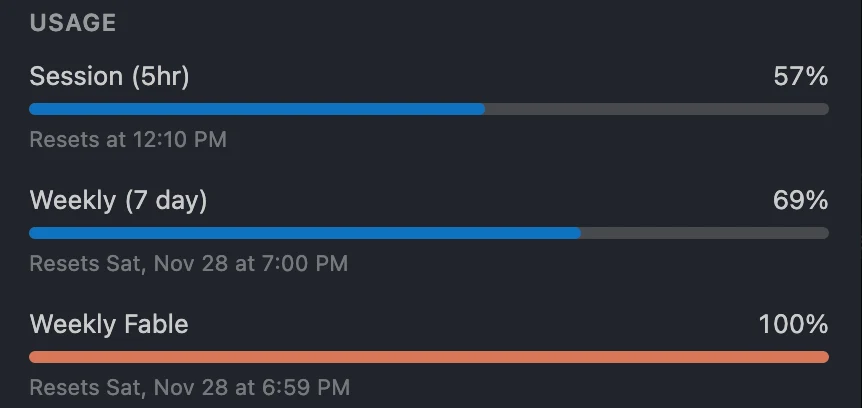
The rest of my allowance still had room. The model I actually work with did not.
I am cutting everything else
I am building a business right now, and I am careful with every dollar.
I run no ads. I do my outreach by walking into shops. I use every free tool I can find. The research tools I use run out of free credits all the time, and I let them. The work slows down, but it keeps going.
I am building all of it on a MacBook Air that grinds to a halt several times a day. I would love a faster machine. I will not buy one until the business has earned it.
So I have a long list of things I could spend money on and choose not to.
AI is not on that list. For every dollar I spend on it, the return is so large that cutting it would be the irrational choice. It is the first thing I pay for.
Maybe it is a bubble anyway
Here is where people usually say: so AI is not a bubble.
I do not think that follows. The internet was enormously valuable, and the dot com bubble still burst. Both were true at once.
The bubble question is not whether AI is useful. It is whether the money pouring into it, the data centres, the chips, the share prices, will ever be earned back. That is a question about the price.
My Wednesday says nothing about the price. It says a great deal about the value. Someone counting every dollar, with every reason to cut, would rather lose a laptop than lose this.
The bubble is in the structure
So where is the bubble? I think it is in the structure of the US stock market. The market has come loose from the lives of most of the people in the economy it is meant to measure.
Chamath Palihapitiya said it on the All-In podcast on 7 November, in an episode about the midterms and a $4 trillion sell off in AI stocks:
"I think what they are shouting now, and they were trying to signal, and now they are shouting, is a broad-based belief that the economy has completely decoupled from reality and is broken. The economic reality in America is broken. There is a small percentage of people, the four of us on this pod and all of our friends, who are the asset owners of America. And we have benefited in every weather condition."
He went on: "And then there's everybody else who are wage earners and the structural capacity of the American economy to support and grow wage earners is broken."
 Midterm Blood Bath, $4T AI Sell Off, Data Center Freeze, What's Next for TrumpAll-In PodcastWatch Chamath say it
The next day he put it in writing, and started by admitting he had it wrong: "When I'm wrong, I'm wrong. I thought when unemployment was low, GDP was hi, household income rose, it meant everyone was winning. Not true." (His post on X.)
When the people who own assets and the people who earn wages move that far apart, prices stop telling you much about the real economy. They tell you where the money of the people who already have it is going. Right now a lot of it is going into AI.
That is why I think the price can be a bubble while the value is real. AI is where the money is landing. The structure underneath is what is inflating it.
The market may well correct. That does not change what I will pay.
What I did next
I did not upgrade.
I was at the end of the hardest stretch of building: one last complex piece of work, with most of the heavy lifting already done. That is the work the best model is for, and it was worth every dollar.
The rest of this month is different. It is sales and outreach. Writing to people, planning visits, keeping track of who said what. The model one step behind the best is more than enough for that.
So I matched the model to the job. The best one for the hardest work, and a good one for everything else.
That is how a careful buyer behaves when the value is real. A bubble is when people pay for the newest thing because it is the newest thing.
Where the value is
There are two kinds of work going on in AI.
One is the frontier: building ever more capable models. I hope the people working there are managing it well, and keeping the science fiction endings out of reach. It matters. But it is not where most of the value is.
Most of the value is in diffusion. The models we already have, some of them months old and some close to years, can already do far more than most businesses use them for. The work now is getting them into the real world: into a small shop's website, a clinic's bookings, a parent's week.
If you run a business, here is one place to start. Pick the one task you do every week that you dread most. Write down how you do it, step by step, and give it to the AI model you already have. Not the newest one. The one you already pay for, or the free one. You will be surprised how much of it is done.
I finished the hardest build on the best model there is. The rest of this month is sales and outreach, and the model one step behind it is more than enough for that.
That is the whole argument. The value is not only at the frontier. Most of it is in the models we already have, doing ordinary work, every day.
A free assessment, about fifteen minutes
