
What Google, Meta and Amazon actually sell
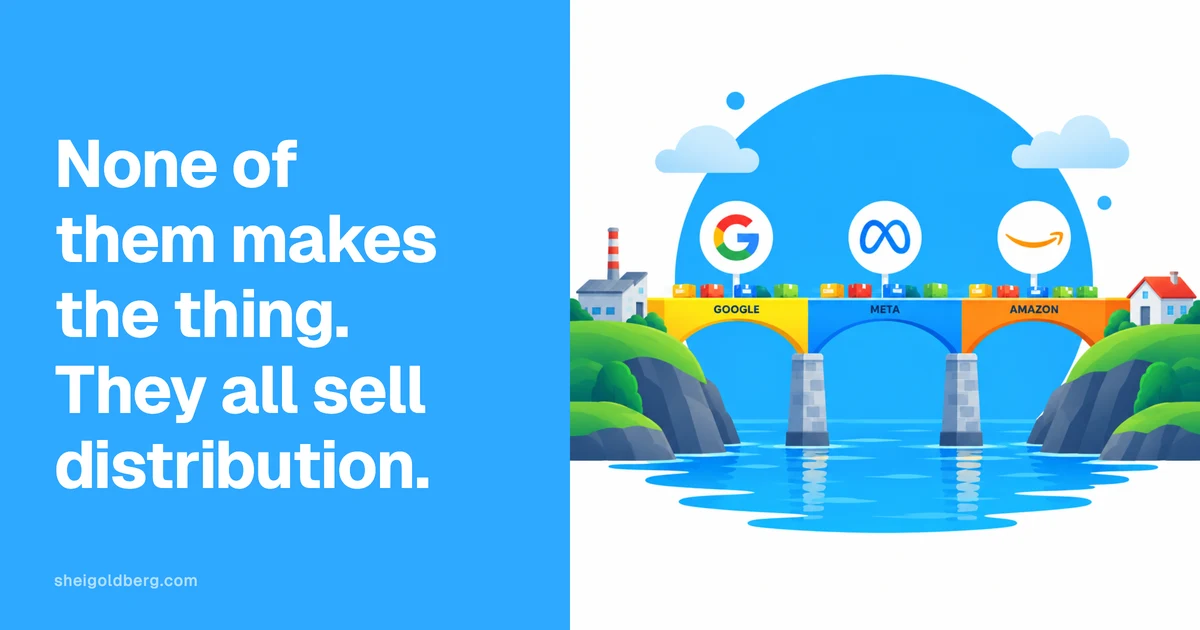
Three of the largest companies in the world are all built on the same idea. None of them makes the thing. They all sell distribution.
Distribution is the ability to put your product in front of other people. Not making the product. Not improving it. Getting it in front of somebody who wants it. It is the least impressive sounding thing in business and it is the most valuable thing you can own.
Google. For most of its life, more than 90 percent of its money came from one job: connecting a person looking for something with the thing they were looking for. That is all it was. Somebody typed what they wanted, and Google put it in front of them. In 2011 that was 96 percent of the company. Last year, after fifteen years of determined effort to be something else, with the phones and the cloud and the Other Bets losing seven billion a year, it was still 73 percent of $402.8 billion.
Meta. Most of its money comes from helping businesses put their products in front of people. Last year that was $196.2 billion out of $201.0 billion. That is 98 percent, and there is nothing to discuss.
Amazon. This is the one that moves the atoms, and people think that makes it a different kind of company. It does not. AWS is 18 percent of it. The other 82 percent is distribution in the most literal sense there is. Third party seller services alone are $172.2 billion, which is a toll Amazon charges on products it does not own, make or buy. Somebody made a thing, somebody else wants it, and Amazon stands in the middle and takes a cut of the meeting.
Three different companies. One business.
As I write this, those three are about 12 percent of the S&P 500 by market value. The whole index is worth around $68.8 trillion, so call it eight trillion dollars of company, built on standing between a product and a person. Close to one dollar in eight.
To be exact about what that number is: it is 12 percent of what the market thinks these companies are worth, not 12 percent of what the index sells. Their combined revenue is $1.3 trillion, which is a much smaller slice. The market is not pricing their sales. It is pricing the position.
Here is the part that does not fit. The two largest weights in that index are Apple and Nvidia, and neither of them is this. Nvidia makes a physical object almost nobody else on earth can make. Apple takes a serious toll through the App Store, but what it sells is hardware it designed. Between them they are more than 14 percent. So making things is not finished, and I am not going to pretend it is.
The honest version is narrower. If what you make is genuinely rare, make it, and the world will come and find you. For everybody else the making is the available part and the attention is the scarce one.
Notice the order all three of them followed. Google had the searches before it had AdWords. Facebook had the users for years while people asked how it would ever make money. Amazon spent two decades being mocked for not turning a profit while it quietly became the place where buying happens.
Get the people. Work out the money later.
Most small businesses do it exactly backwards. They perfect the offer first, then go looking for people to tell. By then, getting that offer in front of anybody is exceptionally expensive, because they never built any distribution of their own.
Small businesses should think hard about this. They are far too focused on making the thing, and they pay almost no attention to the distribution.