
I bought a standing desk and never stood at it
TL;DR
- A hand cranked standing desk is just a desk, because the purpose dies in the effort of changing it.
- An $800 vacuum and a $120 vacuum, and why the cheap one was the better machine.
- Fifteen seconds of boot time, and the kind of work it quietly deletes.
- Two kinds of lever: when the purpose is a result, and when the purpose is a habit.
- The lever is almost never the feature on the box.
My first standing desk had a crank.
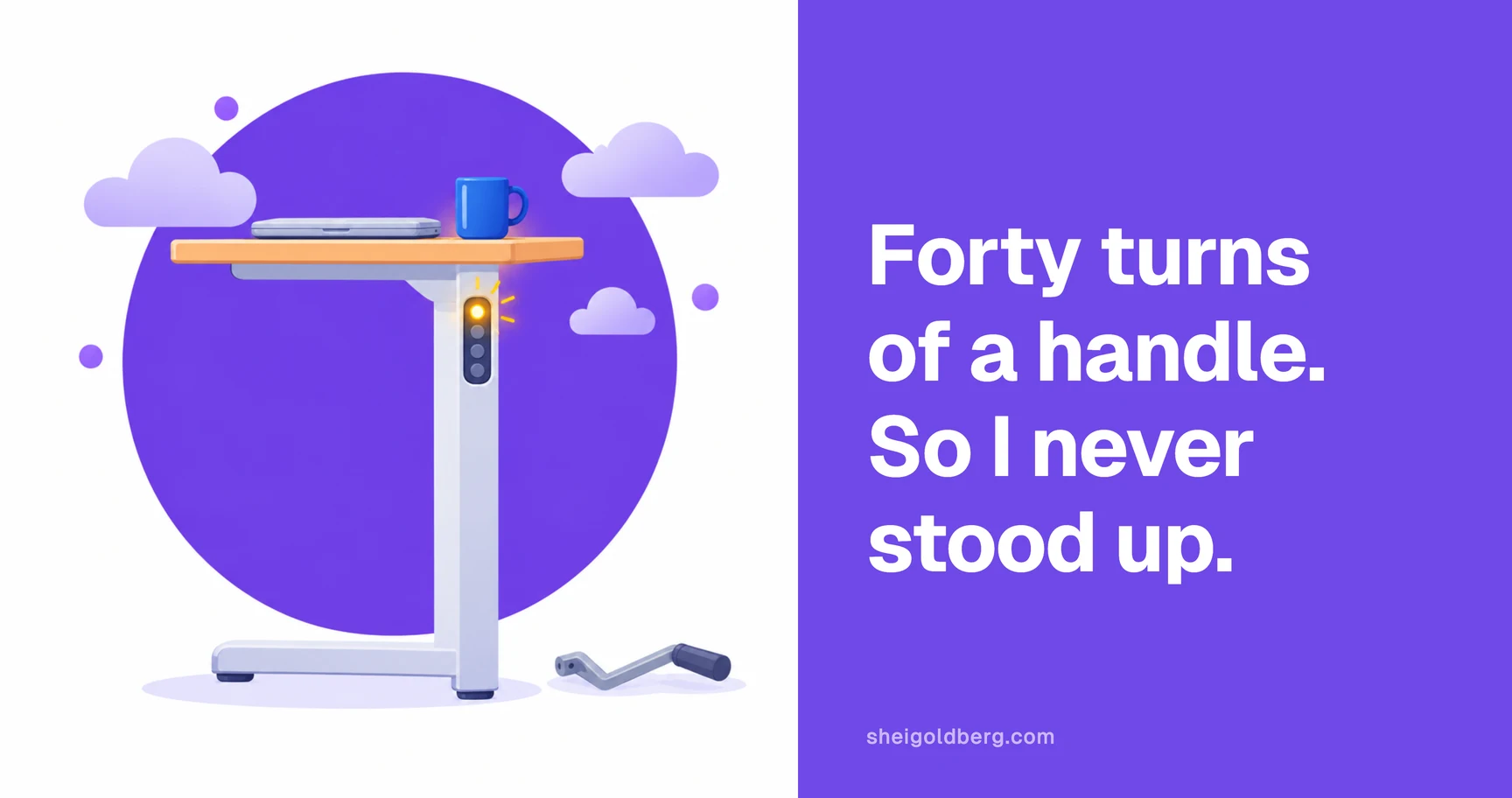
You turned a handle on the side, the way you would wind down a car window in 1994, and the desk rose a few centimetres a turn. Going from sitting to standing took about forty turns. Going back took forty more.
I used that desk for a long time. I almost never stood at it.
The purpose was never standing
This is the part that took me a while to see. A standing desk is not for standing. If standing all day were the point, you could achieve it with a bookshelf.
What is actually good for your back is not standing. It is changing. Forty five minutes up, then forty minutes down, then up again. The benefit lives in the transition, which means the transition is not a feature of the product. It is the product.
A crank puts a price on every transition. Not money. Forty turns, a small ache in the shoulder, and a two minute interruption to whatever you were in the middle of.
Nobody decides to stop using a standing desk. You simply find, every single time, that this is not the moment to stop and wind a handle. Then one day you notice you own a very expensive desk that goes up and down and has been at one height since March.
The electric one I replaced it with has four buttons. I press one, walk away to pour a coffee, and come back to a desk that is already at standing height. I did not have to want it very much.
A desk that costs two minutes gets raised when you really want it. A desk that costs nothing gets raised because you happened to think of it. Those are not the same product, and only one of them is a standing desk.
The vacuum cleaner
We left every appliance behind when we came to Canada, because the plugs do not fit and shipping a kettle across an ocean is a strange thing to do. So we had to buy a vacuum cleaner, and we went in with the sensible mindset. Buy well, buy once, get something that lasts years.
Which is how I ended up reading about cordless Dysons, and the robot ones that look like a disc and drive themselves around your living room while you are out. Eight hundred dollars, give or take.
Then I noticed what I was actually choosing between.
A vacuum cleaner has one job and it is in the name. Everything else on the spec sheet is paid for out of the same budget. Cordless buys freedom from the plug and spends motor power and runtime to do it. Robotic buys not having to be there and spends almost everything.
None of that is a scandal. They are honest trades. But I had drifted into comparing features without noticing that the feature I cared about was the one all the others were being funded from.
What settled it was that we had spent a month in an Airbnb with a cheap little vacuum cleaner that just worked. Not impressive in any way. It had a cord. You had to push it. And the floors were clean.
We looked it up. A hundred and twenty dollars.
We bought that one, and it has been one of the best purchases we have made since we arrived. It vacuums. That was always the entire assignment.
Carl's MacBook
My friend Carl bought a MacBook around 2009, years before I did, and spent a while trying to explain why it was so much better than anything else he had used. He kept returning to one thing, and at the time I thought it was an odd thing to care about.
You open the lid and you are working.
I was on Windows. Open the laptop, wait for it to wake, wait for the login, wait for the spinner, wait while several programs that start themselves decided to start themselves. Twenty seconds, give or take, before the machine was mine.
Twenty seconds against two. Carl was telling me that this was the headline feature of his computer and I did not believe him.
I have one now. He was right, and the reason is not the fifteen seconds.
The reason is what fifteen seconds does to how often you open it.
If sitting down to work is free, you sit down for a four minute thought. You open the lid to write one paragraph, to check one number, to finish a sentence that arrived while you were making tea. If sitting down costs twenty seconds and a password, none of that happens. Not because you decide against it. Because four minutes of work behind twenty seconds of waiting does not feel like a sensible trade, and you are not even aware of making the judgement.
Friction does not reduce your work evenly. It deletes a whole category of it: the short visit. And over a year, the short visits are a startling amount of what actually gets finished.
Two kinds of lever
Those three stories are not all the same story.
The vacuum is a product whose purpose is a result. Clean floors. When the purpose is a result, the lever is whatever produces the result, and every other feature is quietly funded out of it. The discipline is to find the one capability the result depends on, refuse to trade it, and then take whatever convenience is still affordable.
The desk and the MacBook are products whose purpose is a habit. Alternating. Returning to the work. When the purpose is a habit, the lever is not a capability at all. It is friction. The machine can be entirely capable of the thing and still fail completely, because the cost of doing it is high enough that a normal person on a normal Tuesday does not bother.
The second kind is much harder to see, because the product genuinely does what it claims. My crank desk went up. It went up every single time I turned the handle. It passed every test except the one that mattered, which is whether a slightly tired person in the middle of something would do it.
This is why features that remove friction get dismissed as luxuries. A button instead of a handle sounds like laziness. Two seconds instead of twenty sounds like impatience. They are neither. On a habit product the friction is the product, and the thing that sounds like a convenience is holding the whole thing up.
What this is really about
I am fascinated by the idea that most products have one lever, and that getting it right is worth more than getting ten other things right.
It is rarely the feature on the box, because a box is written to list things and a lever is usually an absence. No cord to wind. No handle to turn. No twenty seconds. Nothing to decide.
So the useful question is not what does this product do. It is what is this product for, and then, what single thing decides whether that actually happens.
Ask it about a vacuum and you get suction. Ask it about a standing desk and you get the button. Ask it about a laptop and you get the lid.
All three of mine cost me something to learn. The crank desk cost me a year of sitting down. The vacuum nearly cost me six hundred and eighty dollars. Carl told me the answer in 2009 and I did not believe him for over a decade.
I am asking the question properly now, because I have a couple of digital products lined up to build. The thing I keep returning to is not which features they should have. It is what each one is actually for, and then what the single thing is that decides whether that happens.
I expect to get that wrong a few times before I get it right. I am going to write about it as I go.
A free assessment, about fifteen minutes
