Where Do Your Leads Actually Go? (A Contact Form Is Not a System)
An enquiry lands in your inbox and then what? The honest case for a simple system of record so no lead slips — and why that's usually worth more than more leads.
Picture a Tuesday. Someone fills in the form on your site at 9:40. The email lands in your inbox, on top of a newsletter and a parking receipt. You're with a client, so you glance at it, think I'll reply after lunch, and then lunch becomes a phone call becomes the school run. By Thursday it's four screens down. By the following week it's gone — and so is the customer, who messaged two other people and went with whoever answered first.
Nobody did anything wrong. There was no system, so a busy human did the human thing.
That gap — between a lead arrives and something reliably happens — is the single most common leak I see. And it's worth saying plainly: closing it is usually worth more to you than getting more leads. You already paid, in money or effort or both, to make that phone ring. Catching the ones already coming is the cheapest growth there is.
A form is a doorbell, not a system
A contact form does one thing: it rings. After that, you're relying on memory, inbox luck, and the hope that nothing more urgent comes in. For a leak or two a month, you can live with that. But you don't actually know how many you're losing, because the ones that slip leave no trace. That's the quiet part — an empty inbox can mean no enquiries or enquiries I never saw, and they look identical from where you sit.
So this isn't really about software. It's about one promise to yourself: nothing that comes in disappears.
What "a system" actually means here
When people hear "system" they brace for something big and expensive. It isn't. A system of record is just one trustworthy place where every enquiry lands and four plain things get tracked:
- Who they are. Name, how to reach them, the one-line version of what they want.
- Where they came from. The form, a referral, a missed call you texted back, the ad you're paying for. (When you can see this, the question which marketing is actually working stops being a guess.)
- What's been said. A short trail — they emailed, you called back, they're thinking about it. So anyone who picks it up knows where things stand.
- What's next. The single most important field. Whose move is it, and by when. A lead with no next step is a lead on its way to being forgotten.
That's it. Who, where from, what's been said, what's next. If you've got those four for every enquiry, in one place you actually look at, you have a system — and the Tuesday story can't happen to you.
You almost certainly don't need an enterprise CRM
Here's the honest part. Search "CRM" and you'll find sprawling platforms built for sales teams of fifty, with pipelines and forecasting and a price to match. For a small service business, most of that is weight you'll carry and never use. Buying one of those to stop losing leads is like buying a forklift to carry the groceries.
What you need is nothing to slip. Plenty of small businesses get there with tools they already own — a simple shared spreadsheet with those four columns, a dedicated label and a follow-up reminder in your email, the lightweight contacts feature built into many booking or invoicing tools. A proper CRM earns its place when you've got real volume, more than one person fielding enquiries, or a sales process with several steps. Until then, the cheap, boring version genuinely does the job. Don't let anyone shame you into more than nothing-slips.
The trap isn't using a humble tool. The trap is having no place at all — letting the inbox be the system, which is the same as having none.
Why this beats chasing more leads
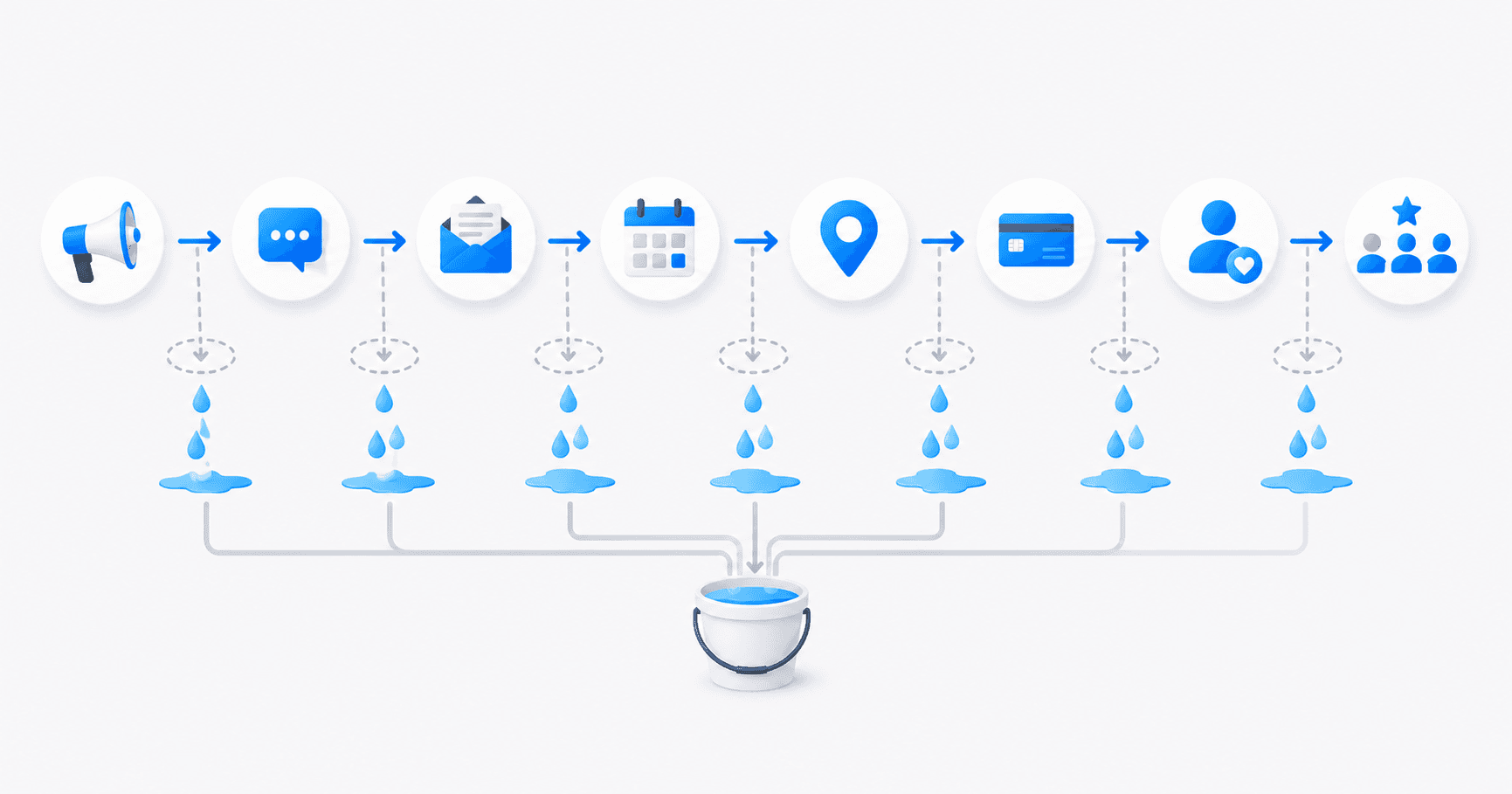
It's tempting to fix a quiet patch by turning up the top of the funnel — more ads, more posts, more reach. But if enquiries are leaking out the bottom, you're pouring water into a bucket with a hole and paying for more water. Patch the hole first. It's nearly always faster, cheaper, and less stressful than finding new people, and it makes every lead you do win worth more. (Why more leads is often the wrong goal goes deeper on exactly this.)
This is one of a handful of places small service businesses quietly lose people, and the most fixable. The fuller map of those leaks lives in where small service businesses lose customers, and the whole picture — site, getting found, the system behind it — is in the buyer's guide.
The good news is how small the fix usually is. You don't need a project. You need one reliable place for leads and a habit of checking it. Most of the value is in deciding it matters.
If you're not sure how many leads are slipping — or whether your inbox has quietly become your system — that's exactly the kind of thing I like looking at. Fifteen minutes, no pitch: you tell me how your business works, I tell you what I see. Have a look here.