Avatar

My notes

Thoughts

Short notes on what I watch and listen to, and what I make of it. Every one in full.

See them as cards

Keep Your Mouf and Do Da Fings
Somewhere around 2012 a colleague of mine, Elrich, got into a lift at Vodacom with a contractor who had been pulling cable in the data centre.

They got talking the way you do for eight floors. Something was not getting done. Some process, some approval, some meeting about a meeting. The contractor had clearly watched a lot of this from inside a ceiling void.

What he said was this.

They just need to keep their mouf and do da fings.

Elrich came back to the IP networking department and repeated it, and that was the end of it as far as the contractor was concerned. He went back to his cable. We kept the sentence for years.

It became the thing we said to each other. A project stuck behind a committee. A change request sitting in somebody's queue for a fortnight. An outage review that had quietly turned into a search for who to blame. Keep your mouf and do da fings.

It was funny the first time and useful every time after that, because it was never really a joke. A man who installs things for a living had looked at a building full of people who talk about things for a living, and summed us up in one sentence.

I thought about him again this morning.

We were talking about how extraordinary AI has become, and my wife pointed out the obvious. It cannot make the coffee. It cannot do the dishes. It cannot vacuum the floor. The washing still gets folded by a person.

Right now AI is all mouth.

It is magnificent at it. It will explain anything, draft anything, argue either side, write you a sonnet about your tax return. What it cannot do is pick up a plate.

I think that changes, and not in a distant science fiction way. The thing that transforms ordinary life is not a better chatbot. It is AI joined to a body. Hands nimble enough to hold a wet glass without crushing it or dropping it. Arms that can reach into a dishwasher. Enough sense to tell a fork from a knife from the pan that is not allowed in the machine.

Maybe five years. Maybe ten. I would not bet against it either way.

When it arrives, somebody will sell it to you with a name about productivity and companionship and reclaiming your evenings.

In my head it already has a name.

The Keep Your Mouf and Do Da Fings robot.

That is the whole product. It does not want to discuss the dishes. It has no view on the optimal loading pattern. It does not send you a notification about how it is thinking. It washes them.

Fourteen years later, a contractor in a lift turns out to have written the spec for the most valuable machine anybody is currently trying to build. He thought he was describing a department. He was describing the gap between what AI is now and what it has to become.

It is also still the best advice about work I have ever been given, and I did not pay a cent for it.
On choosing a silver lining

The second business I wanted as a client here was a shop whose services I actually need.

Their website had not been touched in about ten years. You could tell it had cost real money once. Somebody had put proper work into being found on Google, page after page of it, and then it had been left alone while the rest of the web moved on.

That made them the perfect prospect. The expensive half of the job was already done.

So I did the work before asking for it. A full draft of a new site, every page and every link kept exactly where Google already had them, in a design I was proud of. I showed my wife and she said it was a massive upgrade.

Then I built the offer. Do not pay me $500. Give me $500 of credit in your store and I will spend it with you. Whatever their margin is, the real cost to them was probably half that.

The introduction came through somebody we both knew. I told him plainly that I was going to use his shop either way, offer or no offer.

He said his website had not been touched in ten years. He said he knew it was outdated. He said it was not that important to his business, that he was busy enough already, and that he was happy with the platform he was on.

I had an answer for all of it. You keep your domain. You keep your email address. You own every piece of it. Nothing changes except that the site looks like it was made this decade, and the whole thing costs you a credit note.

I got through every objection. Then he sighed.

Yeah, but then I would be letting down my friend who made the website for me.

And there it was. The real reason, which had nothing to do with any of the things we had just spent ten minutes on.

Here is the part I am less proud of. Somewhere in the weeks of building that offer I had quietly made it the test of the whole business. If a man will not take a modern website for store credit, from someone who is going to be his customer anyway, then what am I ever going to sell to anybody?

I was gutted for about a day.

Then I remembered something I had been chewing on. Tony Robbins calls it the meaning maker. The world you walk around in is not reality. It is reality after it has passed through the thing inside you that decides what events mean. The same event can happen to two people and leave them living in different worlds, because they made different meanings out of it.

So I made a different one.

That man is so loyal to the friend who built his website that he will keep a ten year old site rather than let him down. He will make a decision that costs him money, where people can see it, to protect a relationship. That is not a closed door. That is the most valuable quality a customer can have, and a stranger had just demonstrated it to me for free.

I came into this thinking the technical part was the business. It is not. The work has to be better than what is already there, and it will be. But the relationship is the business, and the technical part is how you earn the right to have one.

A customer who will not walk away from a friend who helped them is a customer who will not walk away from me either. Every one I win is worth more than I thought.

The other thing that helped is a phrase I took from Seth Godin. It's not for you.

That is the whole sentence. You put an offer into the world, it is for some people and it is not for others, and when somebody says no the correct response is not to re-examine your entire life. It is to say, clearly this is not for you, and go to the next door.

There is an enormous amount of freedom in that. It is the permission you need to keep making offers at all.

What Google, Meta and Amazon actually sell

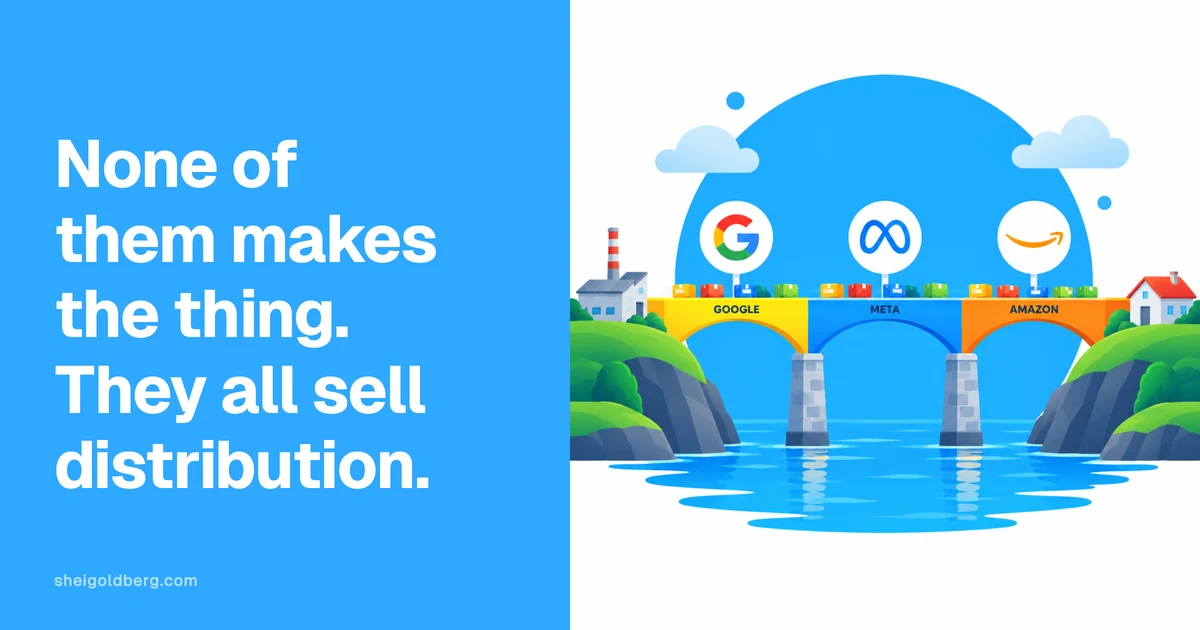
Three of the largest companies in the world are all built on the same idea. None of them makes the thing. They all sell distribution.

Distribution is the ability to put your product in front of other people. Not making the product. Not improving it. Getting it in front of somebody who wants it. It is the least impressive sounding thing in business and it is the most valuable thing you can own.

Google. For most of its life, more than 90 percent of its money came from one job: connecting a person looking for something with the thing they were looking for. That is all it was. Somebody typed what they wanted, and Google put it in front of them. In 2011 that was 96 percent of the company. Last year, after fifteen years of determined effort to be something else, with the phones and the cloud and the Other Bets losing seven billion a year, it was still 73 percent of $402.8 billion.

Meta. Most of its money comes from helping businesses put their products in front of people. Last year that was $196.2 billion out of $201.0 billion. That is 98 percent, and there is nothing to discuss.

Amazon. This is the one that moves the atoms, and people think that makes it a different kind of company. It does not. AWS is 18 percent of it. The other 82 percent is distribution in the most literal sense there is. Third party seller services alone are $172.2 billion, which is a toll Amazon charges on products it does not own, make or buy. Somebody made a thing, somebody else wants it, and Amazon stands in the middle and takes a cut of the meeting.

Three different companies. One business.

As I write this, those three are about 12 percent of the S&P 500 by market value. The whole index is worth around $68.8 trillion, so call it eight trillion dollars of company, built on standing between a product and a person. Close to one dollar in eight.

To be exact about what that number is: it is 12 percent of what the market thinks these companies are worth, not 12 percent of what the index sells. Their combined revenue is $1.3 trillion, which is a much smaller slice. The market is not pricing their sales. It is pricing the position.

Here is the part that does not fit. The two largest weights in that index are Apple and Nvidia, and neither of them is this. Nvidia makes a physical object almost nobody else on earth can make. Apple takes a serious toll through the App Store, but what it sells is hardware it designed. Between them they are more than 14 percent. So making things is not finished, and I am not going to pretend it is.

The honest version is narrower. If what you make is genuinely rare, make it, and the world will come and find you. For everybody else the making is the available part and the attention is the scarce one.

Notice the order all three of them followed. Google had the searches before it had AdWords. Facebook had the users for years while people asked how it would ever make money. Amazon spent two decades being mocked for not turning a profit while it quietly became the place where buying happens.

Get the people. Work out the money later.

Most small businesses do it exactly backwards. They perfect the offer first, then go looking for people to tell. By then, getting that offer in front of anybody is exceptionally expensive, because they never built any distribution of their own.

Small businesses should think hard about this. They are far too focused on making the thing, and they pay almost no attention to the distribution.

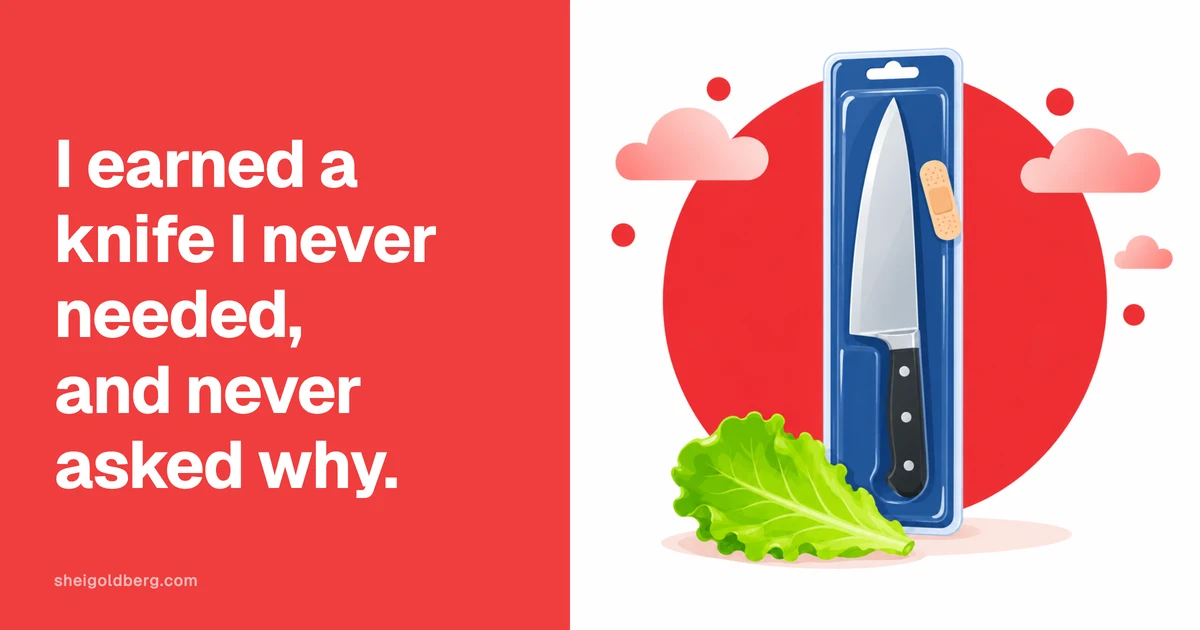
The knife I did not need

Atlantic Superstore has been running a promotion. Collect a stamp with every purchase, fill the card, and you can buy one of ten very good chef's knives for almost nothing.

I started collecting. I did not decide to collect. I just started.

Somewhere around the first half card, something old and stupid in the back of my head woke up and took over. Watching the stamps go down was the good part. Not the knives. The stamps. For two or three weeks I was winning at life, one grocery shop at a time, and I filled two whole cards.

Then I went down to the store and chose the two most expensive knives on the board. A hundred and twenty dollars each, mine for eighteen, because I had the full card and the full card felt like a bingo call.

At no point in that month did I ask myself whether I wanted a knife.

I cut the tip of my finger getting the first one out of the packaging.

It is so sharp that I now treat it like radioactive waste. I know where it is at all times. I am quietly afraid my boys will find it. And the honest truth is that I cut lettuce. I make myself a salad. That is the job.

A knife like this is not better at my job. It is better at a job I do not have.

That is diminishing returns, and then past the bottom of the curve into something worse. The first bit of sharp is enormous: a blunt knife tears a tomato and makes a mess. After that each extra bit of sharp buys me less and less, because lettuce does not care. And then the curve turns and goes under the line, because a blade I am frightened of is worse to own than the one I had.

The part I keep turning over is how little of this was about knives.

Nobody sold me a knife. They sold me the stamps. The stamps had a progress bar built into them, and a progress bar in front of a human being is a kind of mild hypnosis. You stop asking what is at the end and start wanting the next one. I did not evaluate the offer. I played the game.

So two questions I am going to make myself ask.

Would I buy this at full price today. If the answer is no, then what I want is the discount, not the thing.

And where on the curve am I standing. There is a first hour on almost anything that pays for itself ten times over. There is a tenth hour that buys almost nothing. And on some things there is a twentieth hour that actively makes it worse, and the only way to know is to ask out loud.

Both knives are still in the kitchen. They will outlive me, and they will probably outlive my children.

I will not be using them. I will be using the old one, on the lettuce.

Every business has a golden goose

A shop owner told me recently that he didn't need a website. He had enough business.

He was probably right. But that was not the end of the conversation, and I let it be.

The question I should have asked was this. What is the most profitable thing you sell? And could you use a lot more of it?

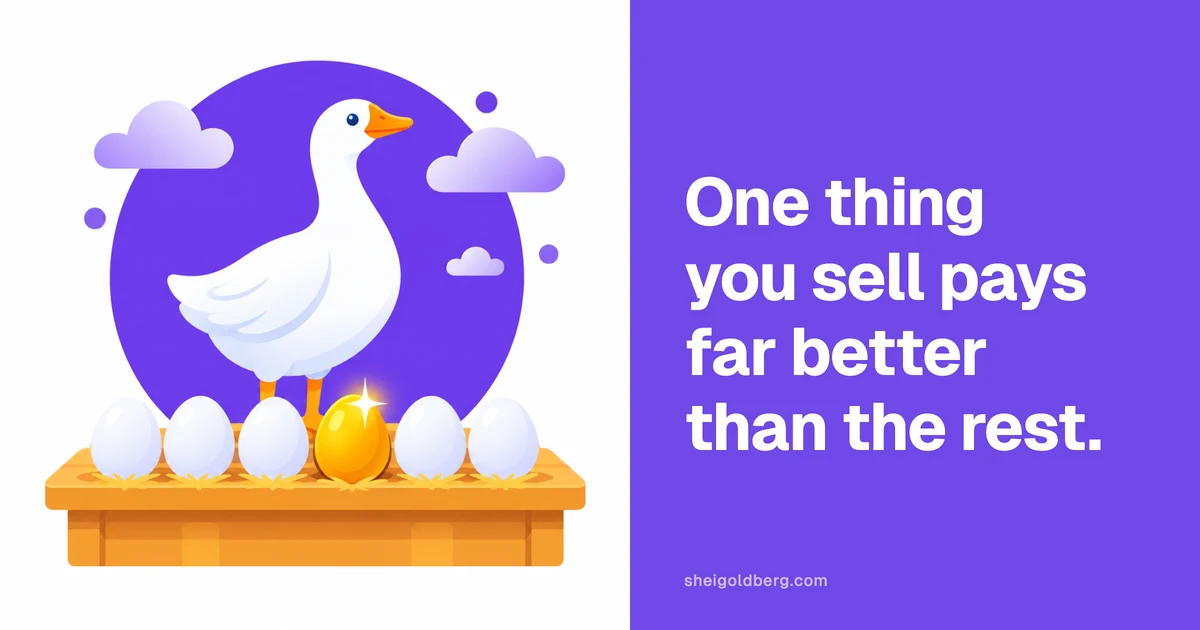
I call that thing the golden goose of a business.

Every business sells a mix of goods and services. Some of them pay well. Some barely pay at all. The owner usually knows which is which, even if they have never said it out loud.

Change the mix, and the same number of customers can bring in a lot more profit.

Frankie Fihn calls it the $100 bill. He explains it on ItsKeaton's channel, at 17:01:

So, every business has a multitude of things they sell, and they never value those things equally.

His advice to people who build websites is simple. Don't sell a website. Sell more of the golden goose.

instead of just saying I'll make you a website, I'll make you a website to sell your $100 bill.

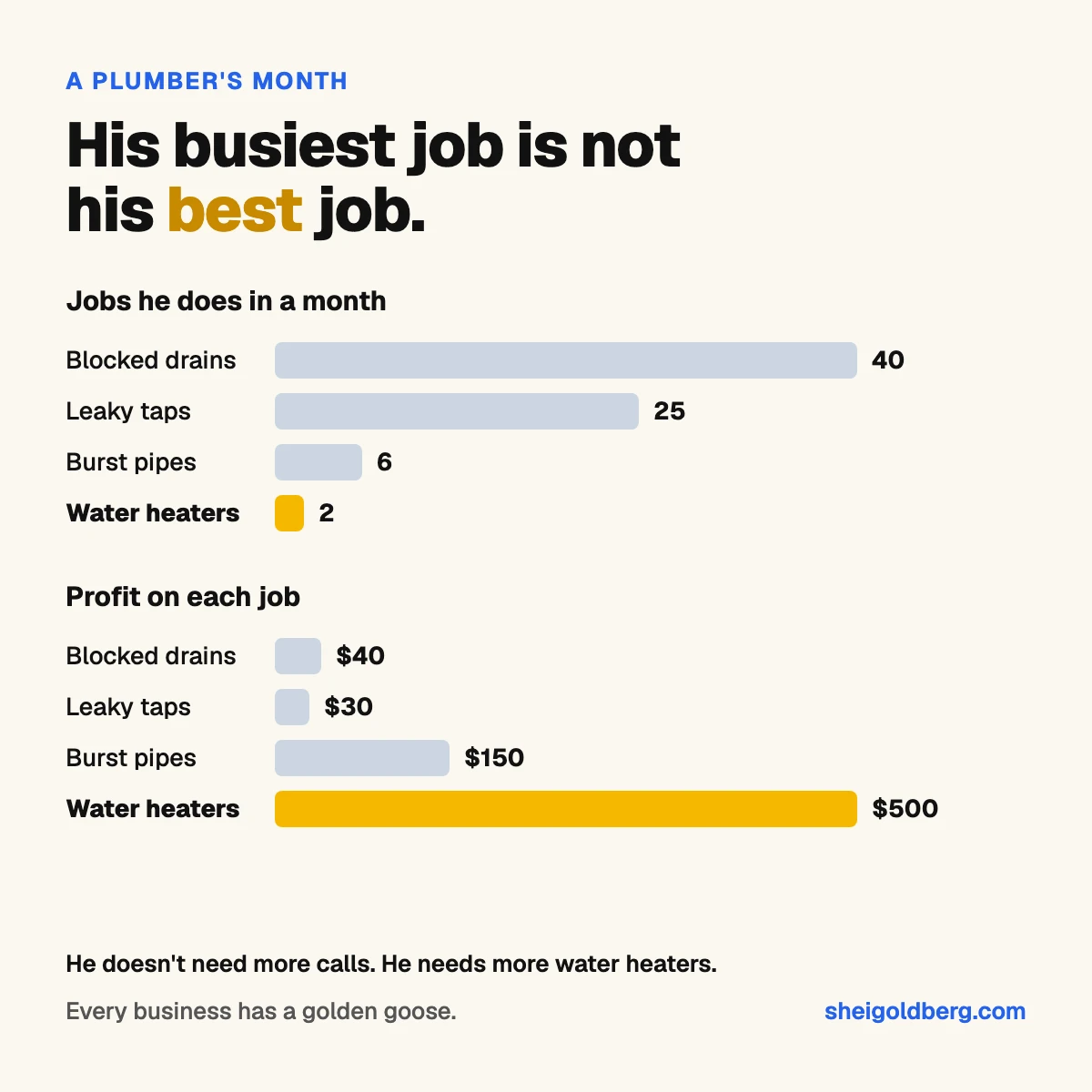
Take a plumber who is busy all week.

A blocked drain is a call out. Say it pays $150. Most of that hour goes on the drive there and back. A burst pipe at 3 am pays more, and it costs him his sleep.

A new water heater is different. Say it is $2,500 installed. It is half a day's work, booked a week ahead. There are a few hundred dollars of profit in it.

He doesn't need more calls. He has calls. He needs more water heaters.

So his website should not say "plumbing services" above a list of twenty things. It should be built around the water heater. What it costs. How long it takes. What happens if you wait until the old one floods the basement. And a button to book the visit.

Two bar charts for a plumber. Blocked drains are 40 of his jobs a month but make $40 each. Water heaters are 2 jobs a month but make $500 each.

Now take a coffee shop.

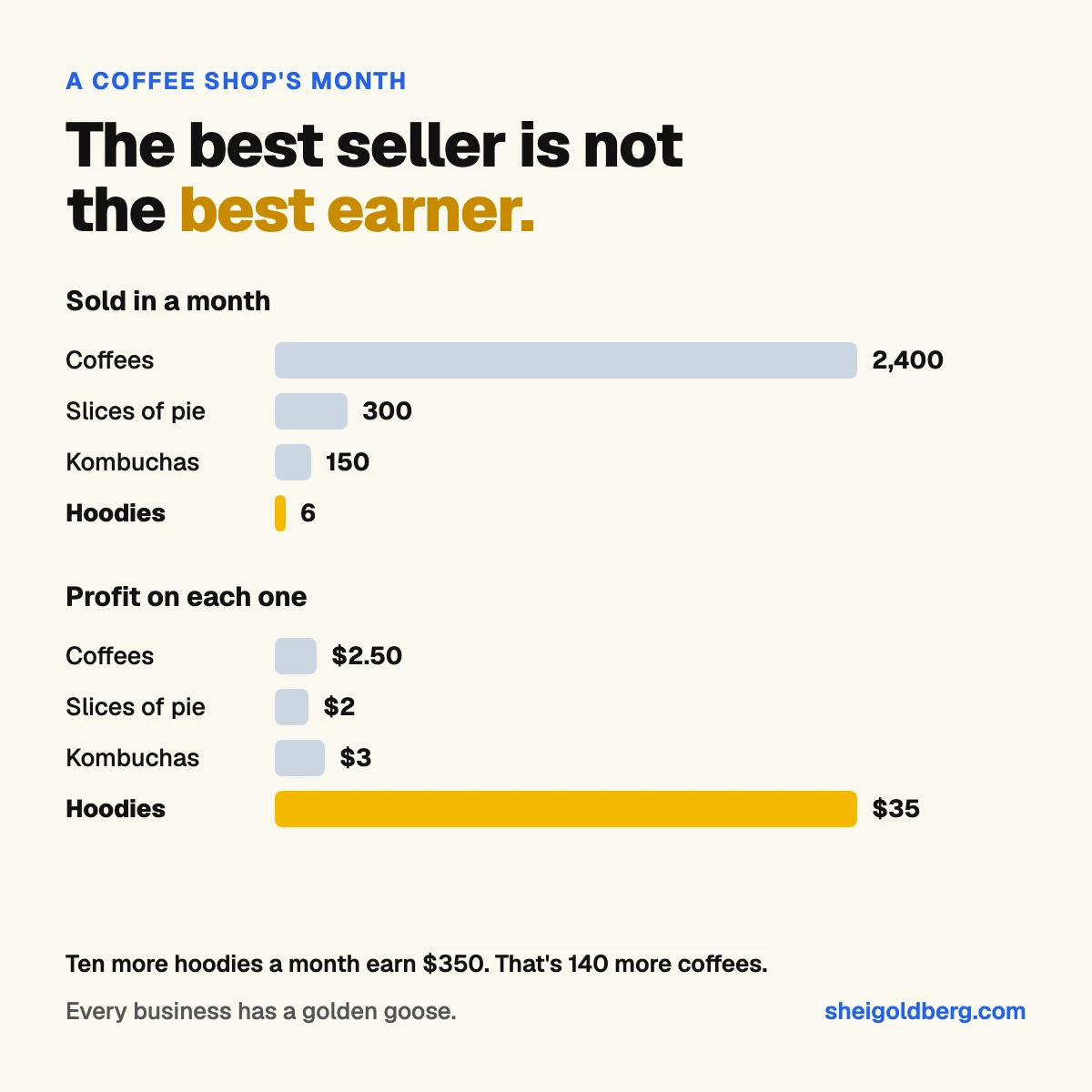
Coffee is what it sells most. A cup costs very little to make, so most of the price is profit. But each cup only makes about $2.50.

The shop also sells pie, kombucha and a few hoodies with its name on them. Say a hoodie sells for $60 and makes $35. That one sale earns as much as fourteen coffees.

So the shop doesn't need a longer line at 8 am. It needs to sell more of what pays most on each sale. Ten more hoodies a month earn $350. That is 140 more coffees, with no extra line.

The website should sell the hoodie. A photo of a regular wearing one. A way to buy it online and pick it up with a coffee. A gift idea for the holidays.

Two bar charts for a coffee shop. Coffees are 2,400 sales a month but make $2.50 each. Hoodies are 6 sales a month but make $35 each.

"A website" is a hard thing to sell. "More of your best job" is an easy one.

So start with the question. What is your golden goose? Then build the website, and the marketing around it, to bring in more of that one thing.

An owner with enough business is still happy to have that conversation.

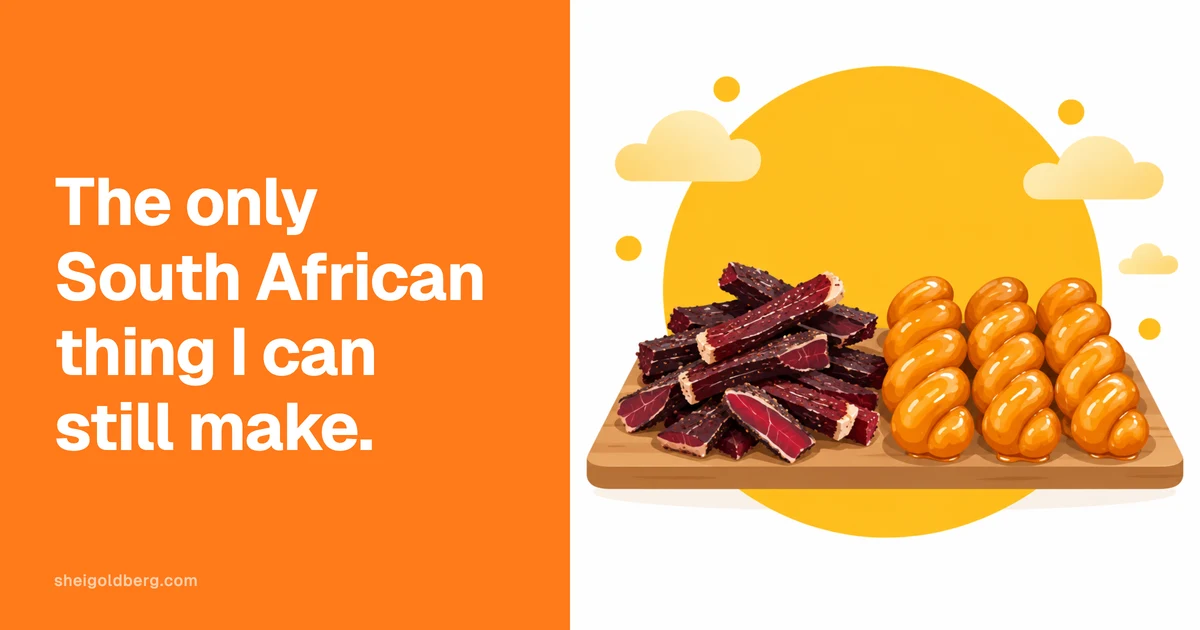
My wife makes the biltong. I make the koeksisters.

We moved to Canada in May.

Today my wife made her first batch of biltong.

I am vegetarian, so I cannot tell you how it tastes. I can tell you it looks right and it smells right, and she and the kids have been feasting on it all afternoon.

I am so impressed with her. We have been struggling to find a decent source of protein for the kids' lunches since we got here. She has just made that ten million times easier.

Then I started wondering what South African speciality I have brought over.

And I remembered.

On our scouting trip in December, a Canadian family invited us to dinner. I went to a lot of trouble and made homemade koeksisters.

They were actually decent. Much better than I expected.

For anyone who did not grow up there: biltong is cured meat that men are strangely proud of, and koeksisters are a sticky plaited doughnut soaked in syrup.

So there it is. We emigrated to Canada. My wife makes the biltong and I make the koeksisters.

This does not reflect well on my manliness.

I think it might be time to concede that she wears the pants in this relationship.

Give the AI the long letter

There is an old line, usually credited to Blaise Pascal. "I'm sorry I wrote you such a long letter. I didn't have time to write a short one."

The short letter was the hard one. Someone had to take all the messy thinking and boil it down.

With AI agents, I think this is flipped.

When you tell an agent what you really want, don't try to write the short prompt. Give it the long one. Give it all the messy details. Go back and forth. Say this, then change your mind and say that.

All of that is information it uses. The work of turning a long letter into a short one used to be ours. Now the AI does it, and it does it without effort.

Lex Fridman described this on his podcast with DHH, at 2:16:43:

So I, I run with this thing. It's called Plaud. So I, I just hook it up on my, you know on my T-shirt here... I speak a long prompt, like, and a lot of it, it's like stream of consciousness reasoning. So I'll sometimes just change my mind about a design, but all of that is in there.

And then you have this gigantic thing that's often 10, 15, 20 minute me discussing the full design, and I find that to be really, really powerful. Because it doesn't have the problem... of overspecification.

There's been prompts that I had for an hour, and I'm just running and... speaking. I highly recommend people try a voice-based... speaking for prolonged periods of time.

That got me thinking about how I work.

A massive unlock in my own AI work has been Wispr Flow. I talk to the AI instead of typing to it. Talking is slower than thinking, but it is much faster than typing. So I can say far more, and what I give it is deeper and richer.

I haven't gone as far as Lex. I don't do twenty minute prompts yet. Mine are more back and forth. I talk for thirty seconds, maybe a minute, and then we go again. Even that is much better than when I typed.

I am not sponsored by Wispr. But hey, Wispr, if you are interested, I would love to do a deal.

Joking aside, it is an incredible product.

The next car question

Every salesman on a car lot is asking the same question when somebody walks on. How do I sell this person a car?

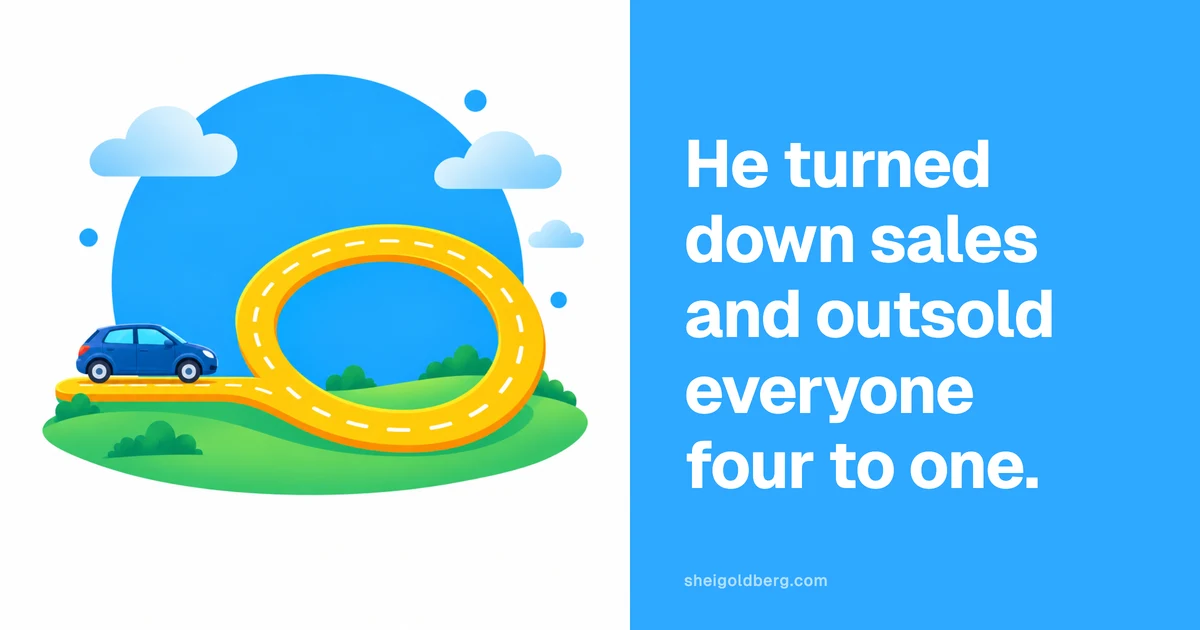
Rory Sutherland tells the story of one who asked something else. I heard it from Chris Dylan, a WhatsApp automation expert, on ItsKeaton's show. A salesman in America in the sixties, outselling everyone around him four to one. Asked why, he said that everyone he knew in the trade asks how to sell a car to the person in front of them. He asked himself what he could do today to guarantee they came back to him for their next one.

Then comes the part of the story that is easy to skip.

For his first three or four years, his numbers were average. Some of them slightly below average. He was turning away sales he could have closed, because closing them would have cost him the one after.

So for three or four years he looked like a man with a worse strategy than everybody else, and he would have had no way to prove otherwise.

Then people started needing their next car. They did not shop around. They asked what he had.

I am starting a business. I have spent months on foundations rather than on sales, and the honest description of where that leaves me today is the first part of his story, not the second.

So the question I keep coming back to is not how I sell somebody a website.

It is how I make certain I am the person they come back to for their whole web presence, in ten and in twenty years.

That changes what I build. It changes what I say in a first conversation. It changes what I tell someone not to buy.

A website I could sell today and a website still earning for someone in ten years are not the same website. Only one of those two questions tells you which one you are building.

It also tells you to expect a few quiet years first.

Working out in jeans

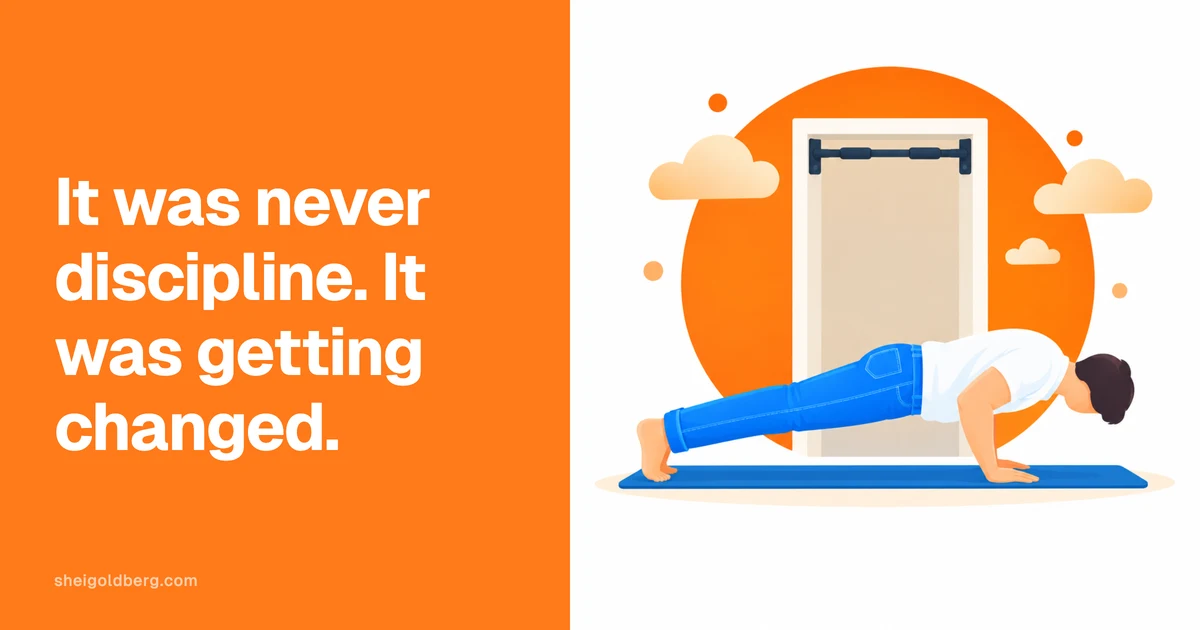
Yesterday I did my ten minute calisthenics workout in my jeans.

Not gym shorts. Jeans, and the shirt I had been wearing since breakfast.

I had always assumed the thing standing between me and regular exercise was discipline. It turns out it was laundry.

What I actually want here is small and regular. A yoga mat on the floor, the pull up bar in the doorway, ten minutes, most days. That is the whole plan. There is no event. Nobody is watching.

And the ten minutes was never the hard part. The hard part is everything wrapped around it. Find the shorts. Change. Do the ten minutes. Decide I should probably shower now. Change again.

So it is ten minutes of exercise inside half an hour of admin, and the half hour kept winning. Which is a polite way of saying the ten minutes kept not happening.

So I took the changing out. I walked past the mat in what I was already wearing, did the ten minutes, and carried on with my day.

It worked. The jeans were fine. I was fine. Ten minutes is not hard enough to need a shower, which is the part I had been getting wrong all along. I was budgeting for a workout I was never actually going to do.

Now the part I am less sure about.

Optimising hard against one number is usually how you get into trouble. Here the number is friction, and I am pushing it to zero. That is not obviously the right thing to do. Balance probably matters more than any single measure, and something usually gets lost when the only thing you are improving is how easy you made it.

So I am not claiming this is the answer. I am testing it and learning. Let's see what happens.

Give your thoughts space to wander

Last night I lay awake from 4 am to 6 am, listening to the kids' hamster run on its wheel. Non-stop.

I have no idea what the hell is going on with that little creature. I didn't know hamsters were nocturnal. I didn't know they were marathon runners in the early hours of the morning.

But I take it as a blessing. The spinning was just enough to keep me awake. It was not enough to fill my attention.

It left me with something I didn't know I was missing: time and space to think. Time to let my thoughts wander and percolate, and see what comes up.

The modern world is all about efficiency and productivity. AI and media come at us from every angle. I hadn't noticed that I'd stopped giving myself the gift of wide open space, where my attention can roam free.

Some amazing thinking came to me in those early hours. I thought around and through problems I was facing. I had never given them the time and space to see the opportunities in them.

So I've decided something. The drive home after dropping the kids off is 15 to 20 minutes, along a beautiful Nova Scotia highway. I'm not going to listen to the latest NFL news, or a podcast. I'm going to sit in silence and see where my thoughts take me.