
Your Website Isn't a Brochure. It's One Part of the System That Creates Your Customers.
The whole picture of how a business gets found, trusted, chosen, paid, and referred — why one constraint governs the whole system, and how to find and fix yours first.
Here's a scene you'll recognise.
Someone types your kind of business into their phone at 9pm. They find you. They spend ninety seconds on your site — decent photos, a services list, an About page — and then they do the thing that quietly costs you more than any ad ever could: they hit back, and they call the next name on the list.
Why? Not because you're worse at the work. They never got close to finding that out.
They left because the site gave them nothing to do and no reason to believe. They had three questions — can this business solve my problem, can I trust them, and can I get this moving tonight — and the page answered none of them. No reviews they could check. No answer to the question they were actually asking at 9pm. No way to book, no promise anyone would respond before tomorrow. Just a description, politely waiting to be read.
The next name on the list had forty-one Google reviews, a line that said exactly what they do and for whom, and a button that booked a slot for Tuesday. That business wasn't better. It was just switched on at the moment of decision — and at 9pm, switched on wins.
The real business is a customer system
The reflex at this point is to conclude "I need a better website." Resist it — that conclusion is how good businesses end up buying the wrong thing.
A website is one component in a larger machine: the system that creates and keeps your customers. That machine runs a journey every customer travels, whether or not anyone designed it:
They find you → they believe you → they choose you → they pay you → they come back → they send a friend.
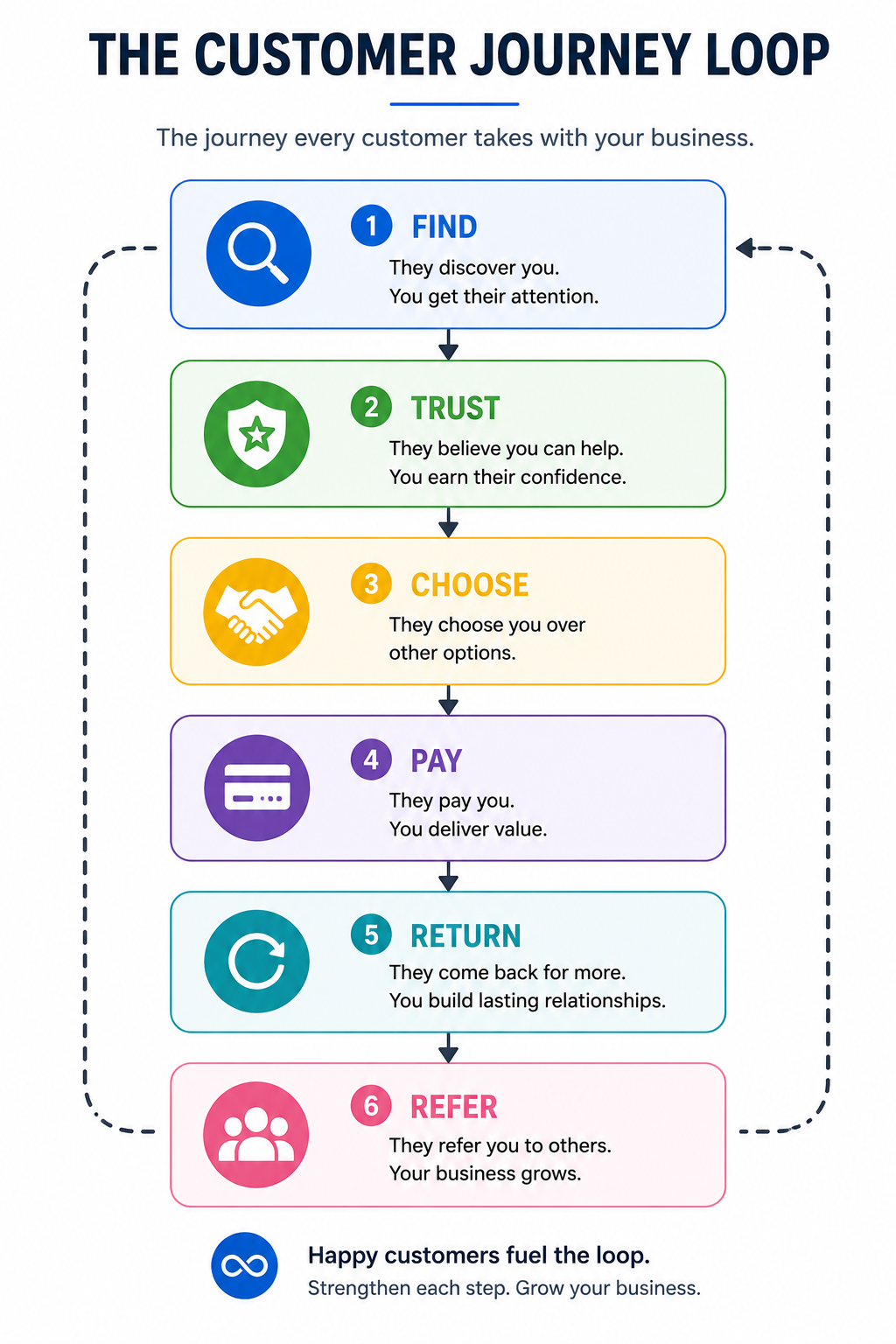
Every business has this system. Most owners have never looked at it end-to-end, because it's spread across a website, a Google profile, an inbox, a phone that goes to voicemail while you're with a client, a pile of unpaid invoices, and a vague intention to "stay in touch." Each piece belongs to a different tool, a different habit, a different afternoon. Nobody owns the whole.
And so the system leaks — not dramatically, but quietly, in ways that never look like a breakage. A missed call here. An enquiry answered two days late there. A delighted customer who was never asked for a review, never followed up, never reminded you exist. Each gap just looks like "business was a bit slow this month."
One constraint governs the whole system
Here's the idea this entire library is built on, and it comes from the theory of constraints — the most useful thinking tool an operator can own:
A chain is only as strong as its weakest link. At any point in time, one constraint limits the performance of the whole system more than any other — and strengthening the other links barely registers.
Your customer system is a chain. If strangers can't find you, it doesn't matter how persuasive your site is — nobody's on it. If they find you but see no proof they can trust, more traffic just means more people bouncing. If they trust you but enquiries sit unanswered for two days, every dollar spent on ads is buying leads that go cold in your inbox. The bottleneck upstream makes everything downstream irrelevant; the bottleneck downstream silently wastes everything upstream.
This is why so much money spent on "marketing" produces nothing. It's not that the ads were bad or the redesign was ugly — it's that they strengthened a link that was never the weakest one. Effort applied anywhere except the constraint is invisible in your results.
(Sharp readers will object that parts of the system run in parallel — referrals and search can both feed you at once, and sometimes two cheap fixes beat one deep one. True. But at any moment one link still binds the whole, and find the binding one first remains the right search discipline either way.)
The corollary is genuinely good news: you don't need to fix everything. You need to find the one link that's currently governing your whole system, and fix that. Then — and only then — the next weakest link becomes worth your attention.
The map: the chain, its instrument panel, and its foundation
This library walks the chain link by link — what each one is, how it leaks, and what's honestly worth your money.
Get Found — strangers can't hire you if they can't find you. The classic leak: excellent practice, invisible at the moment of need.
↳ Get Found by AI — the find link's second front door, deep-dived: when someone asks ChatGPT who to call, the answer is the shortlist. The leak: being recommendable nowhere an assistant looks.
Earn Trust — found isn't believed. The leak: no proof a nervous stranger can check at 9pm.
Get Chosen — believed isn't booked. The leak: the enquiry that sat unanswered for two days.
Get Paid — booked isn't banked. The leak: the invoice you're still chasing a month later.
Keep Your Customers — the profit is in the second sale. The leak: the delighted client you never contacted again.
Measure What Matters — the instrument panel over the whole chain. The leak: numbers that go up and prove nothing.
The Foundations — underneath everything: your domain, your hosting, your email. The question: do you actually own your own front door?
How to use this map
Like an operator, not a shopper. The method is a loop:
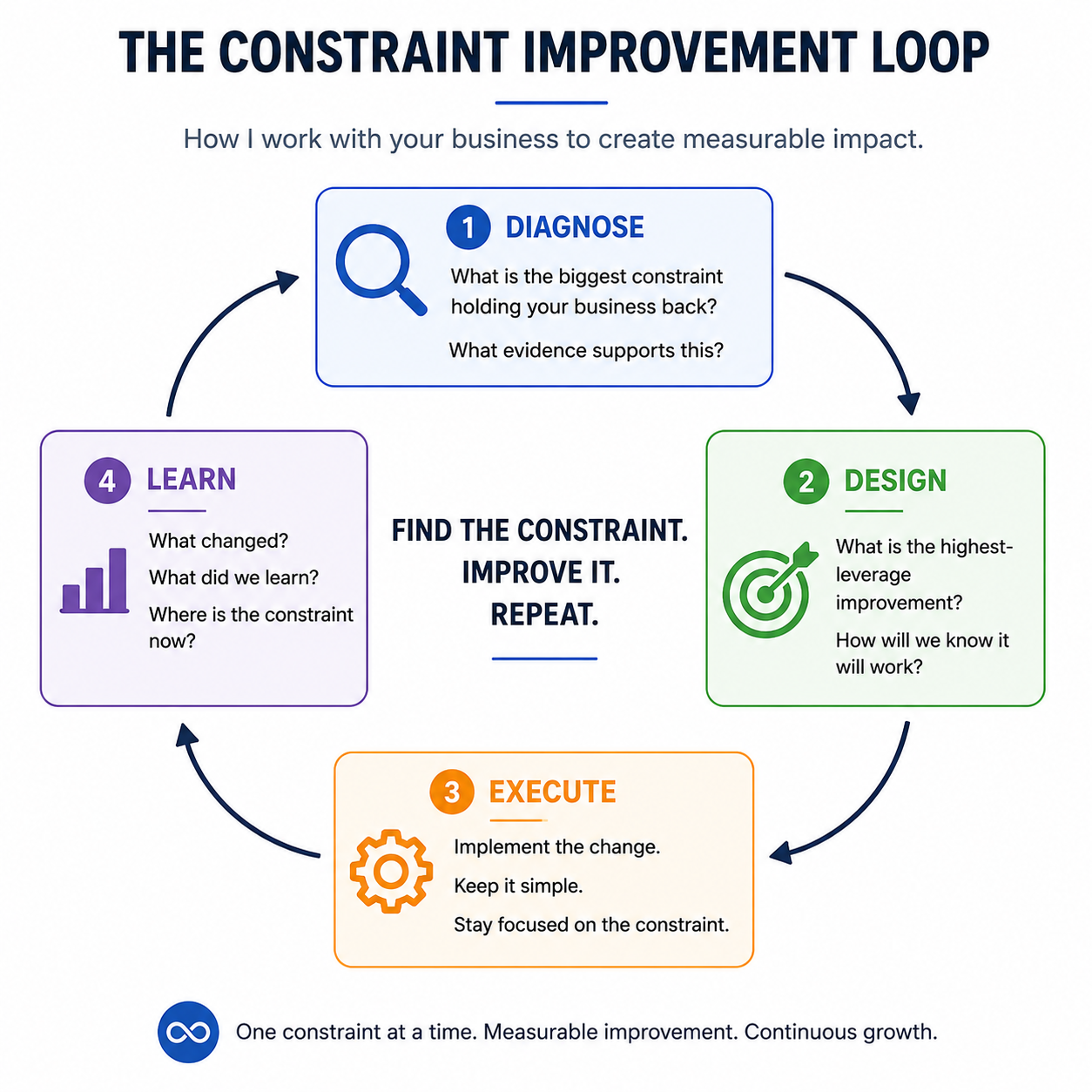
- Diagnose. Walk your own chain honestly, with numbers where you have them. Where do the most people fall out? Which link, if it doubled in strength, would change your month? (The Find Your Constraint walkthrough takes you through this step by step.)
- Design the smallest fix. The smallest system that genuinely removes the bottleneck. Not the platform with nineteen features. Not the redesign. The specific fix for the specific leak.
- Execute — that link only. Implement it properly, keep it simple, and resist improving three other things while you're in there.
- Learn. Measure whether it worked — not "does it look better," but did more strangers become customers? Every improvement changes the system: once one constraint is removed, another becomes the limiting factor. So the loop runs again — diagnose, improve, measure, repeat. That's not failure; that's the system getting stronger. This is why growing a business is a practice, not a project.
What you should not do is what the industry's incentives push you toward: buy all of it at once. A business leaking at one link doesn't need seven systems — and anyone selling you seven before diagnosing one is telling you something about their business model, not your problem.
How I work (and why this library exists)
I should be plain about who's writing this.
I don't sell websites. I'm a customer acquisition and retention consultant — not a web designer, not a generic AI consultant. My work is exactly the method on this page: diagnose the constraint in how a business gets found, trusted, chosen, paid, and referred — then design the smallest system that removes it. Sometimes that's the website. Often it isn't, and part of my job is telling you so.
I work as an integrator, not a builder. Most businesses don't need another piece of software — they already have too many. They need someone to choose the right tools for their constraint, remove the unnecessary ones, and make the remaining pieces work together as one coherent system that runs while you do the actual work. The individual blocks — booking tools, CRMs, review platforms, follow-up automation — are excellent and getting cheaper by the month. The connective tissue is the scarce thing. That's the craft.
And I run my own business exactly this way. This site is the system I sell — the same capture, follow-up, booking, and measurement machinery underneath, the same diagnosis-first method, dogfooded on myself before any client sees it. This library is that method made public.
Questions worth answering straight
Do I need all of these systems? Almost certainly not. You need the one your constraint calls for, built properly. The rest can wait — some forever.
What if I don't know where my constraint is? That's normal; the system is spread across tools and habits nobody looks at end-to-end. The Find Your Constraint walkthrough exists for exactly this.
Is this just about websites? No — the website is one component. The library covers the whole chain: discovery (including AI), trust, conversion, payment, retention, and the measurement over it all.
How is this different from hiring a marketing agency? An agency sells you its service; the diagnosis comes out wherever its service is. This method runs the other way: diagnose first, then build the smallest fix — which is sometimes not something I sell, and I'll say so.
One next step, and only one: don’t guess where your constraint is. Find your constraint → — the self-assessment designed to identify it.